In industries where petroleum, chemicals, and other volatile liquids are stored, controlling volatile organic compounds (VOCs) is crucial for reducing environmental pollution and adhering to strict regulations. VOCs are harmful to both human health and the environment, and their emission from storage tanks is a significant concern. The implementation of Internal Floating Roofs (IFRs) in storage tanks has emerged as an essential solution to address this issue. IFRs are not only highly effective in reducing VOC emissions but also ensure API 650 compliance, making them indispensable in modern tank storage operations.
This article will explore the mechanisms through which Internal Floating Roofs function, their role in controlling VOC emissions, and their critical contribution to meeting API 650 standards. Furthermore, we will discuss the environmental, safety, and economic benefits of implementing IFRs in industrial storage tanks.
1. Understanding Volatile Organic Compounds (VOC) and Their Impact
What Are VOCs?
Volatile Organic Compounds (VOCs) are carbon-based chemicals that easily evaporate at room temperature due to their low boiling points. These compounds are commonly found in petroleum products, chemicals, solvents, and even natural substances like terpenes emitted by plants. In industrial settings, VOCs are present in fuels, paints, coatings, and various other liquid products.
Health and Environmental Impact of VOCs
VOCs have a broad range of adverse effects on both human health and the environment. On the environmental side, VOCs contribute significantly to the formation of ground-level ozone and smog, which can cause respiratory problems such as asthma, bronchitis, and other chronic respiratory diseases. Ground-level ozone is also a major contributor to air pollution, leading to poorer air quality and environmental degradation.
Additionally, VOCs are known to be greenhouse gases, contributing to the global warming phenomenon by trapping heat in the atmosphere. Many VOCs are also carcinogenic and toxic, leading to long-term health issues for those exposed to high concentrations. For example, chemicals like benzene and formaldehyde, which fall under the VOC category, are known to have severe carcinogenic effects.
VOCs in Storage Tanks
In tanks storing volatile liquids, the majority of VOC emissions occur from the vapor space between the liquid and the tank’s roof. As the liquid evaporates, VOCs are released into the air. The amount of vapor that escapes is directly related to the size of the vapor space and the type of liquid stored. Tanks that do not employ proper emission control measures can release large amounts of VOCs into the atmosphere, contributing to pollution and non-compliance with environmental standards.
2. Role of Internal Floating Roofs in VOC Emission Reduction
How Internal Floating Roofs Function
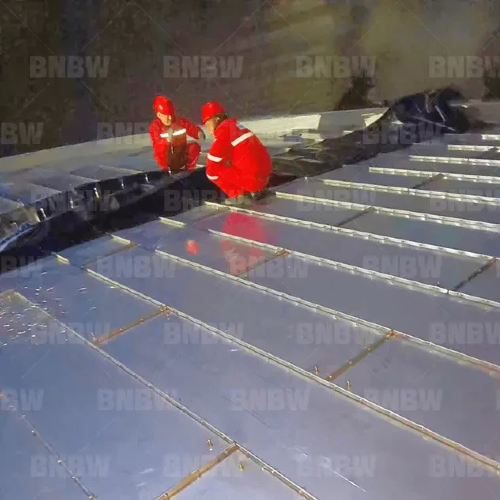
An Internal Floating Roof is designed to float on the surface of the stored liquid, maintaining a tight seal with the tank wall. The roof moves vertically with the liquid level, ensuring minimal vapor space above the liquid and providing a barrier that significantly reduces VOC emissions. As the liquid level fluctuates with changes in temperature or product levels, the floating roof rises or sinks in response, creating a stable environment within the tank that is highly efficient in preventing VOCs from escaping.
Floating Roof Mechanism
The Internal Floating Roof typically consists of a series of pontoons, which are large, sealed containers filled with air or other buoyant materials, or it may consist of a rigid frame. The pontoons or frame support the roof and enable it to float on the liquid surface. These floating roofs are designed to maintain a constant gap between the roof and the liquid surface to minimize the vapor space in the tank.
A critical design feature of IFRs is their ability to form a secondary seal along the perimeter of the tank. This seal ensures that even in the event of slight roof movement or product sloshing, VOCs cannot escape through gaps at the tank's edge. This seal is often made from high-quality materials such as rubber or fluoropolymer, ensuring long-lasting durability and effectiveness.
Reduction of VOC Emissions
The primary mechanism through which Internal Floating Roofs reduce VOC emissions is by minimizing the size of the vapor space above the liquid. The smaller the vapor space, the less room there is for VOCs to evaporate into the atmosphere. This greatly reduces evaporative losses, which can be substantial in the absence of floating roofs. As the liquid level rises or falls with changes in the tank's contents, the Internal Floating Roof adapts to maintain a tight seal and further prevents the release of vapors.
Key Benefits of VOC Emission Reduction:
Benefit | Description |
Reduced air pollution | By limiting VOC emissions, IFRs help reduce the formation of harmful smog and ozone, contributing to cleaner air. |
Improved air quality | IFRs contribute to cleaner air, reducing harmful pollutants that can affect both human health and the environment. |
Compliance with regulations | IFRs help meet regulatory standards set by local, national, and international environmental agencies, avoiding fines. |
Lower product loss | By reducing VOC evaporation, IFRs help prevent valuable liquids from escaping, improving overall storage efficiency. |
3. API 650 Compliance and the Importance of IFRs
Overview of API 650
API 650 is a widely recognized standard developed by the American Petroleum Institute (API) for the design and construction of welded steel tanks used in the storage of petroleum and other liquids. It provides guidelines for tank materials, construction, and safety features to ensure that storage systems are both effective and compliant with environmental regulations. A critical component of API 650 is ensuring that storage tanks are equipped with systems that control emissions, specifically VOC emissions.
How Internal Floating Roofs Ensure API 650 Compliance
API 650 sets specific guidelines for emissions control in storage tanks, requiring that tanks storing volatile substances reduce VOC emissions to meet environmental protection standards. Internal Floating Roofs are a key solution for meeting these requirements by:
Reducing the vapor space to minimize the escape of VOCs.
Providing a secondary seal to prevent leaks around the perimeter of the tank.
Enhancing the safety of the tank by minimizing the risk of fire or explosion from VOC buildup.
By incorporating Internal Floating Roofs, storage tanks can comply with these stringent emission control requirements, ensuring that the tank not only meets API 650 standards but also adheres to broader environmental guidelines set by agencies like the EPA and EU regulations.
VOC Emission Limits in API 650
API 650 defines specific VOC emission limits based on tank size, design, and the type of liquid being stored. For tanks with Internal Floating Roofs, VOC emissions are significantly reduced compared to open-top tanks, helping owners meet these limits more easily. The standard encourages the use of floating roofs as they provide the best control over vapor release, aligning with best practices for environmental protection.
4. Environmental and Economic Benefits of IFRs
Environmental Benefits
Implementing Internal Floating Roofs brings significant environmental benefits, most notably in reducing the carbon footprint and pollution levels. By controlling VOC emissions, IFRs help mitigate the negative impact of the storage of volatile liquids on air quality and climate change. Reducing VOC emissions directly contributes to improving air quality, which in turn reduces healthcare costs associated with air pollution-related diseases.
Economic Benefits
While the initial investment in an Internal Floating Roof may seem high, the long-term savings are substantial:
Reduced product loss: By preventing the evaporation of valuable liquids, IFRs help preserve product quality and reduce financial losses.
Lower maintenance costs: IFRs help maintain tank integrity, reducing the need for frequent repairs and maintenance. Tanks equipped with IFRs typically require fewer repairs and are more resistant to corrosion, leading to longer service life.
Compliance with regulations: IFRs help companies avoid costly fines and penalties for non-compliance with environmental regulations. By adhering to API 650 standards and reducing VOC emissions, businesses can avoid the risk of facing significant financial penalties.
Return on Investment (ROI)
Over time, the economic savings from reduced product loss, lower emissions-related penalties, and reduced maintenance can offset the initial costs of installing an Internal Floating Roof. This makes IFRs not only an environmentally responsible choice but also a financially sound one, providing a solid return on investment for companies.
5. Conclusion
In conclusion, Internal Floating Roofs are essential for reducing VOC emissions and ensuring compliance with API 650 standards in storage tanks. By minimizing the vapor space and providing a strong seal, IFRs prevent VOCs from escaping into the atmosphere, leading to cleaner air and helping industries meet crucial environmental regulations. The implementation of IFRs also offers significant environmental and economic benefits, making them a valuable investment for businesses looking to boost sustainability, enhance operational efficiency, and lower long-term costs.
At Lianyungang Bona Bangwei Petrochemical Equipment Co., Ltd., we specialize in providing high-quality petrochemical equipment, including Internal Floating Roofs. Our expert team is committed to delivering tailored solutions that ensure compliance and optimize tank storage systems. If you're looking to improve VOC emission control and meet regulatory standards, we encourage you to get in touch with us to explore how our products and services can support your business goals. Let us help you achieve a more sustainable and cost-effective operation.
6. FAQ
Q: What is the main purpose of an Internal Floating Roof in storage tanks?
A: The main purpose of an Internal Floating Roof is to reduce VOC emissions by minimizing the vapor space above the stored liquid. The roof moves with the liquid level, creating a seal that prevents vapors from escaping and reducing evaporation losses.
Q: How do Internal Floating Roofs help meet API 650 standards?
A: Internal Floating Roofs help meet API 650 standards by reducing VOC emissions, ensuring that tanks comply with emission control requirements. This is achieved by minimizing the vapor space and providing a secondary seal to prevent leaks.
Q: Are Internal Floating Roofs effective for all types of liquids?
A: Yes, Internal Floating Roofs are effective for storing a wide range of volatile liquids, including petroleum products, chemicals, and solvents. They are particularly useful for liquids that are prone to evaporation, such as gasoline, diesel, and crude oil.
Q: Can an Internal Floating Roof be retrofitted to an existing tank?
A: Yes, Internal Floating Roofs can be retrofitted to most existing storage tanks. Retrofitting is often done to comply with new environmental regulations or to improve VOC emission control in older tanks.
Q: How do Internal Floating Roofs reduce VOC emissions?
A: Internal Floating Roofs reduce VOC emissions by maintaining a tight seal on top of the liquid surface, reducing the vapor space. This minimizes the amount of VOCs that can evaporate into the air, significantly lowering emissions.


